

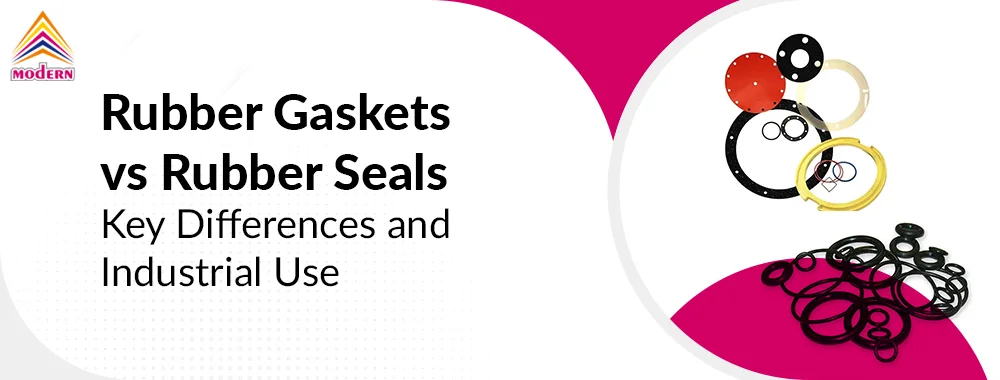
While both rubber gaskets and rubber seals can be used to prevent leaks, they are not synonymous, and using the wrong rubber type in a specific application can result in failure, unplanned maintenance and even safety hazards in pressure critical applications. The difference is simple gaskets are used for sealing in stationary systems while a seal is used for sealing in dynamic systems where at least one of the components is moving. This guide explains how rubber gaskets differ from rubber seals, in what applications each performs best, and the four selection factors that need to be considered to determine which is best for your environment.
What Are Rubber Gaskets?
A rubber gasket is a sealing part that is meant to keep liquid, gas or contaminants between two stationary mating surfaces. The gasket expands when compressed between these surfaces, filling in small gaps and irregularities and forming a secure and leak-proof seal. The EPDM, Nitrile (NBR), Silicone, Neoprene, and Natural Rubber materials are all commonly used to produce industrial rubber gaskets, depending on the environment they are intended to be used in. Common applications of rubber gasket include pipe flanges, pumps, valves, heat exchangers, and storage tanks. Rubber gaskets are used in a variety of industries for different applications, especially in static applications where there is little or no movement between surfaces, to ensure the integrity of the system and enhance operational efficiency.
What Are Rubber Seals?
A rubber seal will exclude the ingress or egress of fluid or contaminant at an interface between two parts when both parts are in motion, either rotating, reciprocating or oscillating. Seals, unlike gaskets, must allow for continuous relative motion without extruding, tearing or losing contact force. Industrial rubber seals are available in a wide range of configurations such as O-rings (radial and face-seal configurations), lip seals and shaft seals (for rotating shaft applications), hydraulic and pneumatic rod seals (reciprocating piston/cylinder applications), and wiper seals (to prevent external contamination). Typical materials include Nitrile (NBR) for hydraulic oil service, Silicone for high and low temperature service, EPDM for water and steam service and Fluoroelastomer (FKM/Viton) for aggressive chemical and high temperature service.
Rubber Gaskets vs Rubber Seals Comparison
| Feature | Rubber Gasket | Rubber Seal |
|---|---|---|
| Function | Creates a leak-proof barrier between two stationary surfaces. | Prevents leakage between moving or rotating components. |
| Surface Type | Used between flat, static mating surfaces. | Used between dynamic surfaces with relative motion. |
| Motion | Designed for static applications with little or no movement. | Designed for dynamic applications involving sliding, rotating, or reciprocating motion. |
| Applications | Pipe flanges, valves, pumps, heat exchangers, tanks, and process equipment. | Hydraulic cylinders, rotating shafts, pneumatic systems, automotive components, and industrial machinery. |
| Pressure Handling | Suitable for low to high-pressure static sealing applications depending on material and design. | Designed to maintain sealing performance under pressure while accommodating movement. |
| Installation | Typically installed between two bolted or clamped surfaces. | Installed within grooves, housings, or around shafts and pistons. |
Common Industrial Applications
While gaskets and seals both perform an important leak prevention and system efficiency function, they are used differently, depending on whether a seal is required to remain static or dynamic.
Where Rubber Gaskets Are Used
Industrial rubber gaskets are used anywhere where a leak-proof, static connection between two surfaces needs to be made. Gaskets are used to contain the process fluid and vapor in the pipeline assembly, specifically between the mating flange of two pieces of pipe, and flanged gaskets are designated by pressure class, flange face type (raised face, flat face, ring-type joint) and by the fluid or vapor to be contained. Gaskets provide containment integrity in process equipment such as reactors, heat exchangers and storage vessels during changing thermal and pressure cycling. EPDM and Fluoroelastomer gaskets are used in chemical processing plants to resist corrosive media such as acids, caustics and solvents. However, gaskets are used at the pump casing, filter housing joints and valve bonnets to keep water from flowing out of the system and from mixing into or out of process streams.
Where Rubber Seals Are Used
Industrial rubber seals are used for applications that contain pressure changes, rotation and movement. They are common in watercraft and hydraulic equipment, where they stop the fluid from leaking around the pistons and cylinders. Engine, transmission and brake systems in automobiles use seals to hold lubricants and out of contaminants. Seals are crucial for the functioning and pressure maintenance in pumps and compressors. In industrial machinery, seals play a vital role in preventing loss of lubricant, dust, and fluid from harming critical machinery parts and in lowering maintenance costs and down time.
How to Choose Between a Gasket and a Seal
Both rubber gasket and rubber seal are used in different industries according to their usage to choose between then some of the points that you need to consider are listed below.
Application Type
The first point to be taken into consideration is whether the application is static or dynamic. Rubber gaskets are used for static sealing, which is a sealing application in which two surfaces stay assembled and do not move. In dynamic systems that require movement, rotation or reciprocating motion, rubber seals are employed. Knowing what type of application you are sealing will also help you decide what solution to use will deliver best performance and reliability.
Pressure and Temperature Requirements
The components are selected based on the operating conditions. There are low pressure and high pressure gaskets and seals available but they have to be designed and made of material that would fit in the system. Other factors to consider include temperature, since high and low temperatures can impact sealing. When selecting the component, choose one that can handle the operating conditions anticipated to avoid early failure and leakage.
Chemical and Environmental Exposure
There is a broad range of gaskets and seals available, ranging from low-pressure atmospheric flanges up to high pressure hydraulic circuits exceeding 350 bar. The most important is that the compound and cross section geometry are defined at the maximum system operating pressure, not the nominal operating pressure, to ensure the ability to withstand pressure peaks and transients.
| Compound | Temperature Range | Best For | Avoid |
|---|---|---|---|
| EPDM | –50°C to +150°C | Water, steam, dilute acids, ozone | Petroleum-based oils and fuels |
| Nitrile (NBR) | –40°C to +120°C | Hydraulic oils, fuels, lubricants | Ozone, weathering, polar solvents |
| Silicone | –60°C to +200°C | High-temperature static sealing, food contact | Petroleum fluids, dynamic high-stress sealing |
| Neoprene | –40°C to +120°C | Refrigerants, moderate oils, outdoor weathering | Strong oxidising acids |
| FKM / Viton | –20°C to +200°C | Aggressive chemicals, fuels, high temperature | Ketones, low-temp applications |
Equipment Design
Many times, the overall equipment design is the reason for or the absence of a gasket or seal. Gaskets are usually used between flat surfaces to be joined such as flanges and covers, and seals are used around shafts, pistons and other moving parts. The knowledge of the equipment configuration is important to ensure the most effective sealing solution.
Conclusion:
The decision of rubber gasket vs rubber seal is extremely crucial. Gaskets perform their function in non-moving areas in between two surfaces, and seals perform their function where the area is moving, rotating or subjected to fluctuating pressures. Selecting the appropriate components enhances the performance of the equipment, reduces maintenance requirements, and ensures its reliability. But there are a lot of factors to think about too, you have to look at conditions like temperature and wear, make sure materials play nice together, and fit with your design plans. With a trustworthy and experienced manufacturer, you can be certain you will receive the very best products that will last. For all your rubber requirements, at Modern Rubber & Plastic, we can provide you with a wide range of rubber components suitable for different industries, ensuring that your operations are smooth and effective.