

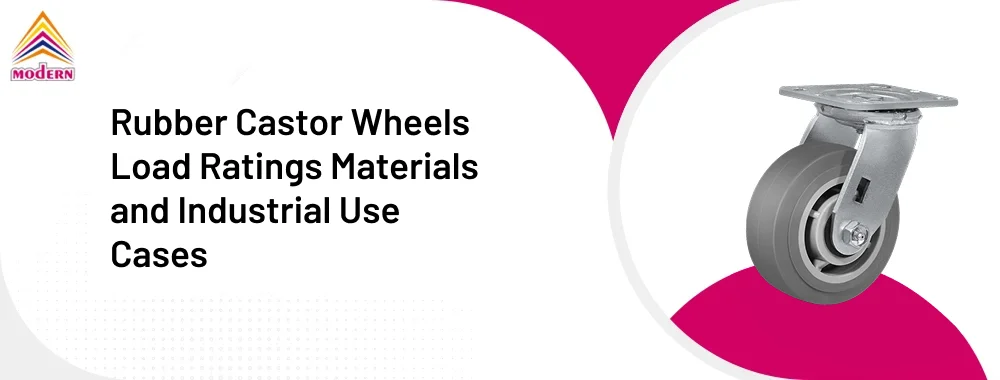
If you have ever spent any time in a factory or warehouse environment, you will know all about rolling a trolley or cart using rubber castor wheels without really thinking twice about them. In a way, that is exactly the idea they should operate silently behind the scenes. However, choosing the incorrect wheel can cause scratches on floors, cart noises, or even the complete failure of the wheel due to load bearing. The key to selecting rubber castor wheels appropriately is based upon three main points: the capacity of the wheels, their composition, and their intended use.
What Rubber Castor Wheels Are Used For
Rubber Castor Wheels can be found wherever smooth movement without floor damage or noise is required. They are installed underneath material handling carts, hospital beds, workstation carts, wheel storage racks, and light-to-heavy industrial equipment. Modern Rubber & Plastic manufactures rubber castor wheels across a wide range of sizes and load grades. Rubber wheels dampen shock and vibration, protect the flooring (usually polished concrete or tile), and roll quietly in comparison with hard wheel materials like nylon or steel.
They can be used wherever the floor protection, noise reduction, or soft goods handling is important which, in most industrial and institutional facilities, is almost everywhere. Contrast that with a hard nylon or steel wheel, which is stronger, but scratches your polished floor, and transmits all the bumps right through to the goods you are carrying. Wherever goods handling, equipment, or quietness is required, rubber wheels should be the automatic choice.
Load Rating Explained: How to Calculate and Select for Your Equipment
This is the bit everybody misses, but it's the cause of most of the problems. Each castor wheel has a load capacity, which is expressed in kilograms per wheel and not for the entire trolley or equipment.
If you need to transport 400 kg using a four-wheeled trolley, it means that each wheel should be able to hold 100 kg. However, in reality, weight distribution is not balanced all the time, and you will also need a safety margin for any uneven floor or turning. It is better to choose wheels with a load capacity far exceeding the calculated one.
It is good to understand the difference between static load (wheel that is supporting the weight and standing still) and dynamic load (the same wheel is rolling and turning around, making corners and facing different obstacles). Dynamic load capacity is always smaller than static one.
As a general guide:
Light-duty wheels (roughly up to 150 kg per wheel) suited to office equipment, light trolleys, and retail use.
Medium-duty wheels (150–300 kg per wheel) suited to general warehousing and material handling.
Heavy duty rubber caster wheels (300 kg and above per wheel) built for industrial floors, heavier machinery movement, and continuous-use applications.
Wheel diameter also affects this. Larger-diameter wheels roll more easily over uneven surfaces and distribute load better, while smaller wheels are easier to maneuver but generally carry less.
Material Options: Solid Rubber, Rubber-on-Cast-Iron, and Swivel vs. Fixed
All rubber castor wheels are not constructed equally, and it has an impact on their performance when carrying weight. Single-piece solid rubber wheels have proven to be durable enough for frequent industrial use and represent an affordable and reliable choice for general purposes when durability is important but superior cushioning is not necessary. Combination of rubber and cast-iron wheels consists of cast iron or steel inner body and rubber cover and combines the durability required for heavy loads with cushioning and noise insulation properties of rubber. It's a great choice when you need both.
Besides choosing the right kind of wheels, you'll have to choose between swivel castors and fixed ones. Swivel castors allow rotating 360 degrees and make handling of equipment in small areas very easy, therefore most trolleys have at least two swivel wheels. On the other hand, fixed castors can move only straight and can handle heavier and more constant loads without putting additional pressure on their mounts. Most industrial machines are equipped with a combination of swivel wheels for movement and fixed ones for carrying weight.
Industrial Use Cases: Material Handling, Machinery, and Racking Systems
Rubber castor wheels show up across a wide range of industrial settings:
Material handling is the most common use hand trucks, pallet trolleys, and stock carts all depend on rubber castors to move goods efficiently without damaging warehouse flooring.
Machinery movement relies on heavy duty rubber caster wheels, particularly the rubber-on-cast-iron type, to reposition equipment across manufacturing floors without needing a forklift for every small shift.
Racking systems mobile shelving and storage racks use castor wheels to allow entire racks to be repositioned for space optimization, a common requirement in warehouses working with limited floor area.
The rubber castor wheels are also present in places where you wouldn’t expect to see them. Panel trolleys, switch gear trolleys, and any other mobile machinery that operates in the vicinity of power supply systems often use rubber wheels as a means of moving safely another field of application where our rubber parts for power sector industry and castor wheels often coincide in terms of industrial purchasing. In all these situations, the wheels serve two purposes – transporting the load and safeguarding the surfaces/equipment that they roll on; hence the importance of wheel rating and materials choice in the purchasing process.
How to Choose the Right Castor Wheel Manufacturer
Choosing the wheel is only part of the decision choosing the best rubber caster wheel manufacturer is equally important, particularly for industrial buyers looking to purchase in bulk quantities. Some aspects that need consideration before deciding on the supplier:
- Can they give precise static and dynamic load ratings instead of general capacity range information?
- Do they have the capability to give consistent quality even when buying in bulk quantities, using grades of rubber that can be traced?
- Do they have solid rubber and rubber on cast iron varieties of rubber casters?
- Have they worked extensively with industrial rubber castor wheels India wide, across various industries like material handling, manufacturing, and power industries?
Dealing with an established rubber products manufacturer, instead of just some random wheel manufacturer is likely to ensure that there will be more consistency in both the compound and the weight handling capabilities, both of which become increasingly important over time.
FAQs
Rubber wheels are softer, quieter, and gentler on flooring, while polyurethane wheels generally handle higher loads and resist wear better on rough surfaces.
Calculate your total equipment weight plus the heaviest expected load, divide by the number of wheels, then choose a wheel rated well above that per-wheel figure to allow for uneven distribution and impact.
They can, but performance depends on the compound rougher surfaces accelerate wear on softer rubber, so a firmer rubber-on-cast-iron wheel is usually a better fit outdoors.
Good-quality rubber wheels are generally non-marking and are actually used specifically to protect floors, unlike harder wheel materials.
It depends on load, usage frequency, and floor conditions, but periodic inspection for tread wear, bearing debris, and flat-spotting will tell you when a wheel needs replacing well before it fails.